

What Industrial AI Gets Built Around: Latency, Data Sensitivity, Ground Truth


A colleague on the manufacturing side once told Silviu Homoceanu’s team that they had tried to reproduce one of its reinforcement learning papers on their digital twin data. It didn’t work. Silviu spent the next seven months finding out why.
The algorithm had been implemented correctly. The data behind the digital twin was not good enough to reflect what actually happens on a shop floor.
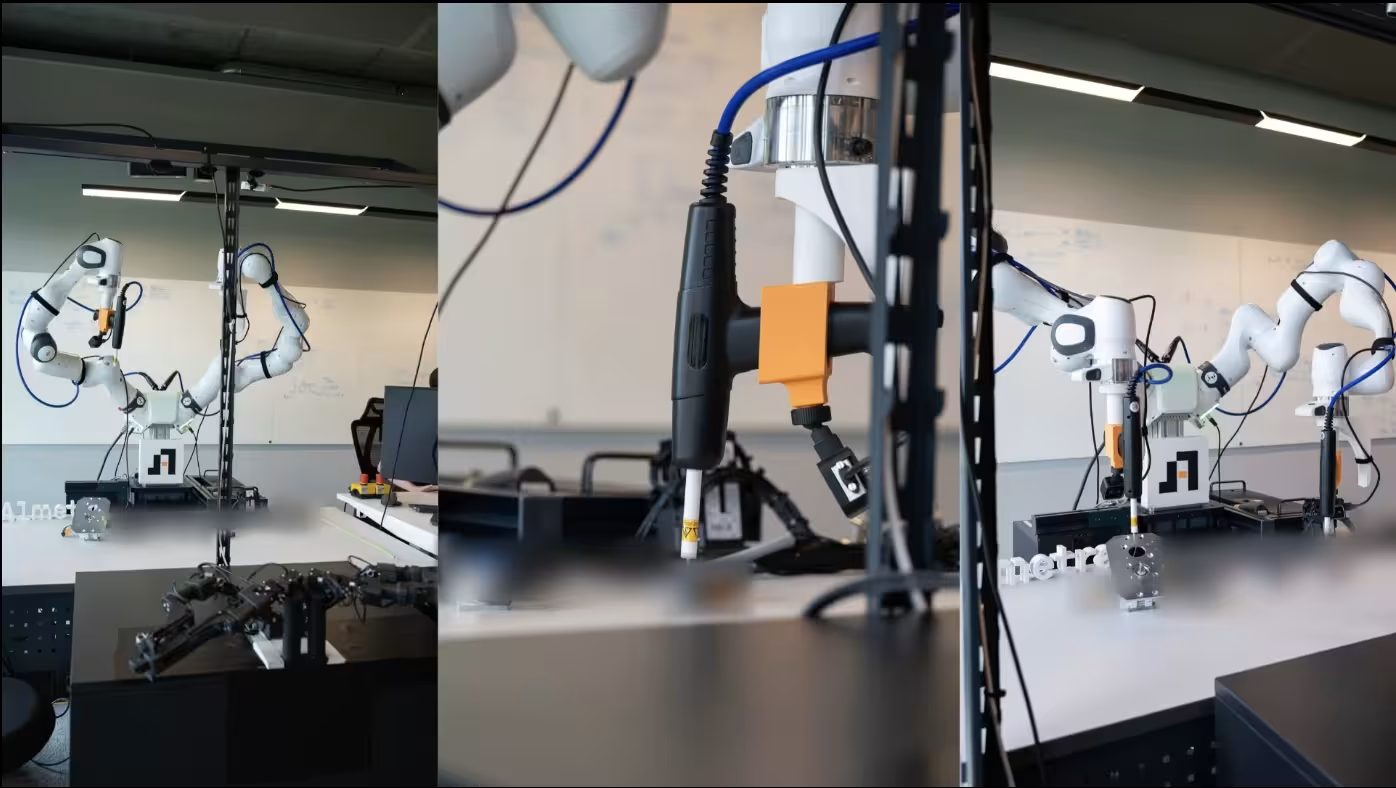
That finding became a company. Silviu and Max Fischer founded Almetra at Merantix in 2022. It puts cameras above production lines and turns what they see into structured process data. This year it raised a $19M Series A, with Merantix Capital among the investors.
Sif Björnsdottir, Chief Community Officer at the Campus, sat down with Silviu to talk about how close physical AI is to the reliability a factory requires, and the four points that matter to anyone building AI for industrial settings.
You have had a front-row view of the new embodied reasoning models. Has physical AI had its ChatGPT moment in manufacturing?
The short answer is no, not yet. That doesn’t mean we won’t get there soon, but in manufacturing we are definitely not there. There is a lot of progress. We see great labs like Physical Intelligence and Generalist AI, and vertically integrated players like Figure for humanoids. Through partnerships with NVIDIA on physical AI and with DeepMind, we have had a front-row seat on these models, especially the embodied reasoning ones.
But if I look at the constraints these robots have to meet, there is a huge gap between a demo on LinkedIn and what needs to happen in the real world. Reliability is key. We handle cases where you have eight seconds to move parts from a complicated, messy tray to a workpiece carrier, and we are not there yet.
In a home or in hospitality, I can imagine a humanoid taking half an hour to load a washing machine, and that is not a problem. If a line at a large automotive plant stops for more than a second, it is expensive. So the ChatGPT moment within manufacturing is yet to arrive. I am confident it will, but it will take a few more evolutions.
Where does each part of your stack run: at the edge, on open weights, or on closed models?
There are a few constraints in our space. We deploy sensors, some of them cameras, at the level of lines and stations, and we capture sensitive data about everything happening in the factory. Imagine that we see how they build their products. Nobody wants that online or handed over to someone else, so all of the processing needs to happen locally.
Everything we train follows a teacher-student paradigm. We started by training our own models, bootstrapped, and realized we needed a large corpus of data. We are four years old, and we spent two of those years building that corpus. Now we can profit from the state of the art in open-weight models. We fine-tune them on our own GPU clusters and deploy them on-site at the customer. A closed option would not be possible there.
Robotics is more complicated because we are talking about edge solutions. You can’t send something to the cloud, wait eight seconds for an embodied reasoning model to think, and then act. That sends us back to open-weight models. Closed models have their place in the agent layer, where any LLM can be the brain and we enrich the harness around it ourselves.
Every line has different tools, layouts and work sequences. How do you keep the cost of a new line low?
The part you can’t shortcut is the corpus. Two of our four years went into it, and that is what a new line now inherits. A new deployment doesn’t start from zero, because the models have already seen a large amount of real assembly work, and fine-tuning does the rest. In practice, it takes about four weeks from installation to first usable data on a new line.
The same logic applies to cost on the device. Compressing the models lets a single edge device cover several stations, so adding a line doesn’t mean adding hardware at the same rate.
Factories change constantly. How do you know when a deployed model no longer reflects the line?
I came to this problem from the other direction. The digital twin that failed to reproduce that paper was a model of a factory that had drifted from the factory. So I treat drift as a measurement problem. A model of a line is only worth the evidence it is checked against.
That is why we do not rely on video alone. We compare what the video says with what the machine data says and with what the people running the line tell us. When those disagree, that is the signal that the model no longer matches the process.
Three constraints ran through our conversation, and none of them is specific to cameras. The cycle time sets the latency budget, and the latency budget decides where compute has to live. The sensitivity of the data decides who is allowed to see it. And any model of a production line is only as good as the evidence it is checked against. Anyone putting AI into a plant, a warehouse or a lab will meet all three, and usually well before the model is the problem.

---
The "Community Spotlight" series explores the conversations happening inside of Europe's most concentrated AI ecosystem. Through interviews between Sif Björnsdottir, Chief Community Officer at the Merantix AI Campus, with founders, researchers, and operators that call the Campus their homebase, the series uncovers the shifts, constraints, and opportunities emerging at the frontier of AI—and what they reveal about where industries are headed next.




Become a part of the AI Campus.
There are many ways to join our community. Sign up to our newsletter below, or select one of the other two options and get in touch with us: